

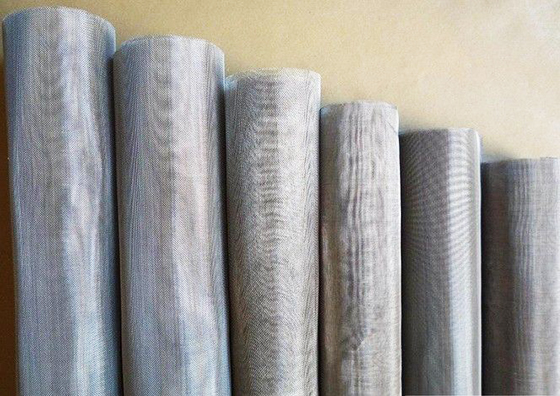
Product Name: 316 stainless steel mesh
Product Brand:
Product Model:
316 stainless steel mesh, also known as 316 stainless steel screen or filter net, is a metal mesh material made from SUS316 stainless steel wire through processes such as plain weave, diagonal weave, and dense weave. It contains 18% chromium, 12% nickel, and 2.5% molybdenum. It is mainly used for screening and filtering operations in acidic and alkaline environments, and is applied in industries such as mining, chemical engineering, food, and medicine.
This material is superior to 304 stainless steel in terms of corrosion resistance, high-temperature strength, and resistance to halogen salt erosion due to the addition of molybdenum. It is particularly suitable for harsh environments such as salt water and sulfuric acid water. The standard mesh size ranges from 20 to 500, with a width of 0.914 to 2.5 meters. Special specifications can be customized, and it can meet the corrosive screening and filtering requirements in industries such as petroleum, chemical engineering, and electroplating.

Advantages
18Cr-12Ni-2.5Mo, due to the addition of Mo, has particularly excellent corrosion resistance, resistance to atmospheric corrosion and high-temperature strength. It can be used in harsh conditions and is less prone to corrosion than other chromium-nickel stainless steels in salt water, sulfuric acid or brine. Its corrosion resistance is superior to that of 304 stainless steel mesh, and it has good corrosion resistance in the production processes of pulp and paper. Moreover, 316 stainless steel mesh is more resistant to erosion from marine and corrosive industrial atmospheres compared to 304 stainless steel mesh.
Specification
The widths of the 316 stainless steel mesh are 0.914 meters, 1 meter, 1.22 meters, 1.3 meters, 1.4 meters, 1.5 meters, 1.6 meters, 2 meters, and 2.5 meters. The mesh count ranges from 20 to 500. Special specifications can be customized.
Purpose
The 316 stainless steel mesh is mainly used for screening and filtering in acidic and alkaline environments. It is also applied in industries such as mining, chemical engineering, food, and medicine.